
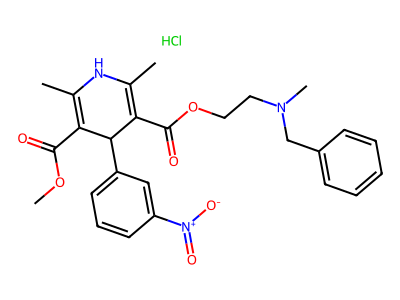
Nicardipine hydrochloride
Also known as: Nicardipine HCl, Cardene, YC-93, UNII:K5BC5011K3, (+/-)-2-(benzyl-methylamino)ethyl methyl 1,4-dihydro-2,6-dimethyl-4-(m-nitrophenyl)-3,5-pyridinedicarboxylate monohydrochloride, 1,4-Dihydro-2,6-dimethyl-4-(3-nitrophenyl)-3,5-pyridinedicarboxylic Acid Methyl 2-[Methyl(phenylmethyl)amino]ethyl Ester Hydrochloride, 2-(Benzyl(methyl)amino)ethyl methyl 1,4-dihydro-2,6-dimethyl-4-(m-nitrophenyl)pyridine-3,5-dicarboxylate hydrochloride, 2-[Benzyl(methyl)amino]ethyl methyl 2,6-dimethyl-4-(3-nitrophenyl)-1,4-dihydro-3,5-pyridinedicarboxylate hydrochloride, 3,5-Pyridinedicarboxylic acid, 1,4-dihydro-2,6-dimethyl-4-(3-nitrophenyl)-, methyl 2-[methyl(phenylmethyl)amino]ethyl ester, monohydrochloride, EINECS 259-198-4, MFCD00057327
Nicardipine hydrochloride (CAS 54527-84-3) is a compound in the Organic Acids category listed in the Jingsj chemical database. It has the molecular formula C26H30ClN3O6 and a molecular weight of 515.986 g/mol. Key properties include a melting point of 176-1780C, a boiling point of 603.4ºC at 760 mmHg and a flash point of 318.7ºC. It is classified under GHS with signal word Danger and hazard statements H301 — Toxic if swallowed, H311 — Toxic in contact with skin and H331 — Toxic if inhaled. No supplier offers are currently listed; request a quote. Record last updated Aug 21, 2026.
- CAS No.
- 54527-84-3
- Jingsj CID
- J-35725-5
- Molecular Formula
- C26H30ClN3O6
- Molecular Weight
- 515.986 g/mol
- Category
- Organic Acids
- Last updated
- 8/21/2026
No offers for this compound yet.
Request a quotePhysicochemical Properties
| Melting Point | 176-1780C |
|---|---|
| Boiling Point | 603.4ºC at 760 mmHg |
| Flash Point | 318.7ºC |
| Exact Mass | 515.182312 |
| PSA | 113.69000 |
| LogP | 5.33180 |
| Additional Property | DMSO: ~1 mg/mL |
GHS Safety & Compliance
- H301 — Toxic if swallowed
- H311 — Toxic in contact with skin
- H331 — Toxic if inhaled
Activity & Biological Data
| Additional Information | [1]. Huang BR, et al. Anti-neuroinflammatory effects of the calcium channel blocker nicardipine on microglial cells: implications for neuroprotection. PLoS One. 2014 Mar 12;9(3):e91167. [2]. Amenta F, et al. Vascular and neuronal hypertensive brain damage: protective effect of treatment with nicardipine. J Hypertens Suppl. 1996 Oct;14(3):S29-35. [3]. Gasior M, et al. Influence of nicardipine, nimodipine and flunarizine on the anticonvulsant efficacy of antiepileptics against pentylenetetrazol in mice. J Neural Transm. 1996;103(7):819-31. |
|---|
Frequently Asked Questions
What is the CAS number of Nicardipine hydrochloride?
The CAS number of Nicardipine hydrochloride is 54527-84-3.
What are the molecular formula and molecular weight of Nicardipine hydrochloride?
Nicardipine hydrochloride has molecular formula C26H30ClN3O6 and molecular weight 515.986 g/mol.
Is Nicardipine hydrochloride hazardous?
Nicardipine hydrochloride has GHS signal word Danger and hazard statements H301 — Toxic if swallowed; H311 — Toxic in contact with skin; H331 — Toxic if inhaled.
What are the upstream and downstream products of Nicardipine hydrochloride?
For Nicardipine hydrochloride, Upstream Products: 2-(N-Methyl-N-benzylamino)ethyl acetoacetate, 3-Nitrobenzaldehyde, Methyl 3-aminocrotonate; Downstream Products: N-Benzyl-N-methylethanolamine.
Data compiled from public chemical databases such as PubChem and supplier catalogs; supplier offers are provided by suppliers.
Last updated:
How to cite: Jingsj. "Nicardipine hydrochloride (CAS 54527-84-3)". Jingsj Chemical Database. https://www.jingsj.com/compound/J-35725-5 (accessed 2026-11-09).
Data for reference only; verify product details with suppliers before purchase.