
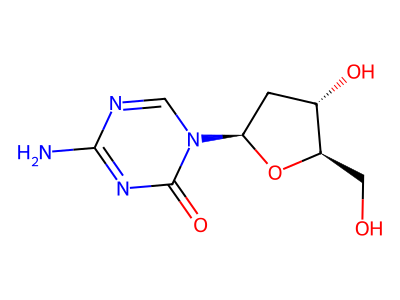
Decitabine
Also known as: 5-Aza-2'-deoxycytidine, DAC, Dacogen, NSC 127716, 2'-Deoxy-5-azacytidine, 4-Amino-1-(2-deoxy-β-D-erythro-pentofuranosyl)-1,3,5-triazin-2(1H)-one, 4-Amino-1-(2-deoxy-β-D-ribofuranosyl)-1,3,5-triazin-2(1H)-one, 5-Aza-2'-deoxycytidine, 5-Aza-CdR
Decitabine (CAS 2353-33-5) is a compound in the Organic Compounds category listed in the Jingsj chemical database. It has the molecular formula C8H12N4O4 and a molecular weight of 228.205 g/mol. Key properties include a melting point of ~200 °C (dec.), a boiling point of 485.8±55.0 °C at 760 mmHg, a density of 1.9±0.1 g/cm3 and a flash point of 247.6±31.5 °C. It is classified under GHS with signal word Danger and hazard statements H302 — Harmful if swallowed, H315 — Causes skin irritation and H319 — Causes serious eye irritation. No supplier offers are currently listed; request a quote. Record last updated Aug 21, 2026.
- CAS No.
- 2353-33-5
- Jingsj CID
- J-35550-0
- Molecular Formula
- C8H12N4O4
- Molecular Weight
- 228.205 g/mol
- Category
- Organic Compounds
- Last updated
- 8/21/2026
No offers for this compound yet.
Request a quotePhysicochemical Properties
| Melting Point | ~200 °C (dec.) |
|---|---|
| Boiling Point | 485.8±55.0 °C at 760 mmHg |
| Density | 1.9±0.1 g/cm3 |
| Flash Point | 247.6±31.5 °C |
| Exact Mass | 228.085861 |
| PSA | 123.49000 |
| LogP | -1.93 |
| Vapor Pressure | 0.0±2.8 mmHg at 25°C |
| Refractive Index | 1.780 |
| Stability | Stable. May be light or air sensitive. Incompatible with strong oxidizing agents. |
| Additional Property | acetic acid/water (1:1): 50 mg/mL |
GHS Safety & Compliance
- H302 — Harmful if swallowed
- H315 — Causes skin irritation
- H319 — Causes serious eye irritation
- H335 — May cause respiratory irritation
- H341 — Suspected of causing genetic defects
- H360 — May damage fertility or the unborn child
Activity & Biological Data
| Target | DNMT1 DNMT3A DNMT3B |
|---|---|
| Additional Information | [1]. Nakamura M, et al. Decitabine inhibits tumor cell proliferation and up-regulates E-cadherin expression in Epstein-Barr virus-associated gastric cancer. J Med Virol. 2016 Jul 19. [2]. Zhang C, et al. Quantitative proteomic analysis of histone modifications in decitabine sensitive and resistant leukemia cell lines. Clin Proteomics. 2016 Jul 5;13:14. [3]. Requena CE, et al. The nucleotidohydrolases DCTPP1 and dUTPase are involved in the cellular response to decitabine. Biochem J. 2016 Jun 20. [4]. Terse P, et al. Subchronic oral toxicity study of decitabine in combination with tetrahydrouridine in CD-1 mice. Int J Toxicol. 2014 Mar-Apr;33(2):75-85. [5]. Yu J, et al. DNA methyltransferase expression in triple-negative breast cancer predicts sensitivity to decitabine. J Clin Invest. 2018 Jun 1;128(6):2376-2388. |
Frequently Asked Questions
What is the CAS number of Decitabine?
The CAS number of Decitabine is 2353-33-5.
What are the molecular formula and molecular weight of Decitabine?
Decitabine has molecular formula C8H12N4O4 and molecular weight 228.205 g/mol.
Is Decitabine hazardous?
Decitabine has GHS signal word Danger and hazard statements H302 — Harmful if swallowed; H315 — Causes skin irritation; H319 — Causes serious eye irritation.
What are the upstream and downstream products of Decitabine?
For Decitabine, Upstream Products: 5-Azacytosine, 1-Chloro-3,5-di-O-toluoyl-2-deoxy-D-ribofuranose, 1-Chloro-2-deoxy-3,5-di-O-(4-chlorobenzoyl)-D-ribofuranose; Downstream Products: 5-Azacytosine.
Data compiled from public chemical databases such as PubChem and supplier catalogs; supplier offers are provided by suppliers.
Last updated:
How to cite: Jingsj. "Decitabine (CAS 2353-33-5)". Jingsj Chemical Database. https://www.jingsj.com/compound/J-35550-0 (accessed 2026-11-09).
Data for reference only; verify product details with suppliers before purchase.