
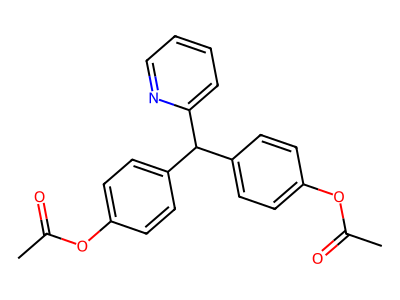
Bisacodyl
Also known as: Dulcolax, Bisacolax, deficol, durolax, ivilax, laxine, neolax, Bicol, Fleet, Purga, Brooklax, 2-(4,4'-Diacetoxydiphenylmethyl)pyridine, 4,4'-(2-Pyridylmethylene)diphenol diacetate
Bisacodyl (CAS 603-50-9) is a compound in the Organic Compounds category listed in the Jingsj chemical database. It has the molecular formula C22H19NO4 and a molecular weight of 361.39100 g/mol. Key properties include a melting point of 131 - 135ºC, a boiling point of 492ºC and a density of 1.2 g/cm3. It is classified under GHS with signal word Warning and hazard statements H315 — Causes skin irritation, H319 — Causes serious eye irritation and H335 — May cause respiratory irritation. No supplier offers are currently listed; request a quote. Record last updated Aug 21, 2026.
- CAS No.
- 603-50-9
- Jingsj CID
- J-35523-7
- Molecular Formula
- C22H19NO4
- Molecular Weight
- 361.39100 g/mol
- Category
- Organic Compounds
- Last updated
- 8/21/2026
No offers for this compound yet.
Request a quotePhysicochemical Properties
| Melting Point | 131 - 135ºC |
|---|---|
| Boiling Point | 492ºC |
| Density | 1.2 g/cm3 |
| Exact Mass | 361.13100 |
| PSA | 65.49000 |
| LogP | 4.11240 |
| Storage Conditions | 2-8°C |
| Stability | Stable. Incompatible with strong oxidizing agents. |
GHS Safety & Compliance
- H315 — Causes skin irritation
- H319 — Causes serious eye irritation
- H335 — May cause respiratory irritation
Activity & Biological Data
| Additional Information | [1]. Ikarashi, N., et al., The laxative effect of bisacodyl is attributable to decreased aquaporin-3 expression in the colon induced by increased PGE2 secretion from macrophages. Am J Physiol Gastrointest Liver Physiol, 2011. 301(5): p. G887-95. [2]. Saunders, D.R., et al., Effect of bisacodyl on the structure and function of rodent and human intestine. Gastroenterology, 1977. 72(5 Pt 1): p. 849-56. [3]. Karmeli, F., R. Stalnikowicz, and D. Rachmilewitz, Effect of colchicine and bisacodyl on rat intestinal transit and nitric oxide synthase activity. Scand J Gastroenterol, 1997. 32(8): p. 791-6. [4]. Rachmilewitz, D., F. Karmeli, and E. Okon, Effects of bisacodyl on cAMP and prostaglandin E2 contents, (Na + K) ATPase, adenyl cyclase, and phosphodiesterase activities of rat intestine. Dig Dis Sci, 1980. 25(8): p. 602-8. [5]. Borrelli, F., et al., Effect of bisacodyl and cascara on growth of aberrant crypt foci and malignant tumors in the rat colon. Life Sci, 2001. 69(16): p. 1871-7. |
|---|
Customs & Trade Information
| HS Code | 2933399090 |
|---|---|
| Summary | 2933399090. other compounds containing an unfused pyridine ring (whether or not hydrogenated) in the structure. VAT:17.0%. Tax rebate rate:13.0%. . MFN tariff:6.5%. General tariff:20.0% |
Frequently Asked Questions
What is the CAS number of Bisacodyl?
The CAS number of Bisacodyl is 603-50-9.
What are the molecular formula and molecular weight of Bisacodyl?
Bisacodyl has molecular formula C22H19NO4 and molecular weight 361.39100 g/mol.
Is Bisacodyl hazardous?
Bisacodyl has GHS signal word Warning and hazard statements H315 — Causes skin irritation; H319 — Causes serious eye irritation; H335 — May cause respiratory irritation.
What are the upstream and downstream products of Bisacodyl?
For Bisacodyl, Upstream Products: 4,4'-(2-Pyridylmethylene)bisphenol, Phenol, Picolinoyl chloride.
Data compiled from public chemical databases such as PubChem and supplier catalogs; supplier offers are provided by suppliers.
Last updated:
How to cite: Jingsj. "Bisacodyl (CAS 603-50-9)". Jingsj Chemical Database. https://www.jingsj.com/compound/J-35523-7 (accessed 2026-11-09).
Data for reference only; verify product details with suppliers before purchase.