
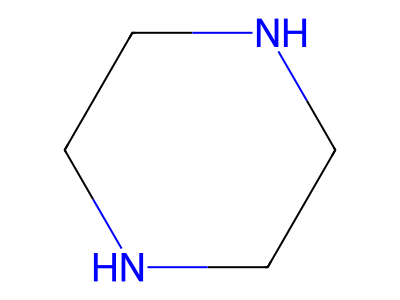
Piperazine
Also known as: 1,4-DIAZACYCLOHEXANE, 1,4-DIAZACYCLOHEXANE, CERTIFIED REFERENCE MATERIAL, 1,4-Diazacyclohexan, 1,4-Diazacyclohexane,Diethylenediamine, 1,4-diazacyclohexane, 1,4-piperazine, AKOS 90646, AKOS BBS-00004315, Anhydrous Piperazine (PIP), DIETHYLENEDIAMINE, Diethylenediamine, EINECS 203-808-3, HEXAHYDRO-1,4-DIAZINE, HEXAHYDROPYRAZINE, Hexahydropyrazine, MFCD00005953, PIPERAZINE, PIPERAZINE CHIPS, Pyrazine hexahydride, Trimetazidine Hydrochloride Impurity G
Piperazine (CAS 110-85-0) is a compound in the Organic Compounds category listed in the Jingsj chemical database. It has the molecular formula C4H10N2 and a molecular weight of 86.136 g/mol. Key properties include a melting point of 109-112 °C(lit.), a boiling point of 149.3±8.0 °C at 760 mmHg, a density of 0.9±0.1 g/cm3 and a flash point of 49.7±10.2 °C. It is classified under GHS with signal word Danger and hazard statements H314 — Causes severe skin burns and eye damage, H317 — May cause an allergic skin reaction and H334 — May cause allergy or asthma symptoms if inhaled. No supplier offers are currently listed; request a quote. Record last updated Aug 21, 2026.
- CAS No.
- 110-85-0
- Jingsj CID
- J-33662-0
- Molecular Formula
- C4H10N2
- Molecular Weight
- 86.136 g/mol
- Category
- Organic Compounds
- Last updated
- 8/21/2026
No offers for this compound yet.
Request a quotePhysicochemical Properties
| Melting Point | 109-112 °C(lit.) |
|---|---|
| Boiling Point | 149.3±8.0 °C at 760 mmHg |
| Density | 0.9±0.1 g/cm3 |
| Flash Point | 49.7±10.2 °C |
| Exact Mass | 86.084396 |
| PSA | 24.06000 |
| LogP | -1.17 |
| Vapor Pressure | 4.0±0.3 mmHg at 25°C |
| Refractive Index | 1.424 |
| Additional Property | 150 g/L (20 ºC) |
GHS Safety & Compliance
- H314 — Causes severe skin burns and eye damage
- H317 — May cause an allergic skin reaction
- H334 — May cause allergy or asthma symptoms if inhaled
Activity & Biological Data
| Additional Information | [1]. Racz PI, et al. Application of Caenorhabditis elegans (nematode) and Danio rerio embryo (zebrafish) as model systems to screen for developmental and reproductive toxicity of Piperazine compounds. Toxicol In Vitro. 2017 Oct;44:11-16. [2]. Stowe HM, et al. First-principles assessment of CO2 capture mechanisms in aqueous piperazine solution. Phys Chem Chem Phys. 2016 Sep 14;18(36):25296-25307. |
|---|
Customs & Trade Information
| HS Code | 2933599090 |
|---|---|
| Summary | 2933599090. other compounds containing a pyrimidine ring (whether or not hydrogenated) or piperazine ring in the structure. VAT:17.0%. Tax rebate rate:13.0%. . MFN tariff:6.5%. General tariff:20.0% |
Frequently Asked Questions
What is the CAS number of Piperazine?
The CAS number of Piperazine is 110-85-0.
What are the molecular formula and molecular weight of Piperazine?
Piperazine has molecular formula C4H10N2 and molecular weight 86.136 g/mol.
Is Piperazine hazardous?
Piperazine has GHS signal word Danger and hazard statements H314 — Causes severe skin burns and eye damage; H317 — May cause an allergic skin reaction; H334 — May cause allergy or asthma symptoms if inhaled.
What are the upstream and downstream products of Piperazine?
For Piperazine, Upstream Products: Iminodiacetonitrile, Ethylene glycol, Ethylene oxide; Downstream Products: 4,6-Dimethoxy-2-(piperazin-1-yl)pyrimidine, Methyl 2-(piperazin-1-yl)nicotinate, 5-piperazin-1-ylisoquinoline.
Data compiled from public chemical databases such as PubChem and supplier catalogs; supplier offers are provided by suppliers.
Last updated:
How to cite: Jingsj. "Piperazine (CAS 110-85-0)". Jingsj Chemical Database. https://www.jingsj.com/compound/J-33662-0 (accessed 2026-11-07).
Data for reference only; verify product details with suppliers before purchase.