
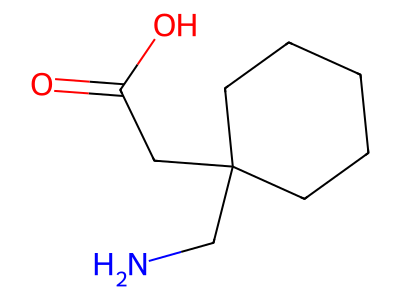
Gabapentin
Also known as: 1-(aminomethyl)cyclohexaneacetic acid, 2-[1-(aminomethyl)cyclohexyl]acetic acid, Neurontin, GOE-3450
Gabapentin (CAS 60142-96-3) is a compound in the Organic Compounds category listed in the Jingsj chemical database. It has the molecular formula C9H17NO2 and a molecular weight of 171.237 g/mol. Key properties include a melting point of 162°C, a boiling point of 314.4±15.0 °C at 760 mmHg, a density of 1.1±0.1 g/cm3 and a flash point of 144.0±20.4 °C. It is classified under GHS with signal word Danger and hazard statements H315 — Causes skin irritation, H319 — Causes serious eye irritation and H335 — May cause respiratory irritation. No supplier offers are currently listed; request a quote. Record last updated Aug 21, 2026.
- CAS No.
- 60142-96-3
- Jingsj CID
- J-33659-4
- Molecular Formula
- C9H17NO2
- Molecular Weight
- 171.237 g/mol
- Category
- Organic Compounds
- Last updated
- 8/21/2026
No offers for this compound yet.
Request a quotePhysicochemical Properties
| Melting Point | 162°C |
|---|---|
| Boiling Point | 314.4±15.0 °C at 760 mmHg |
| Density | 1.1±0.1 g/cm3 |
| Flash Point | 144.0±20.4 °C |
| Exact Mass | 171.125931 |
| PSA | 63.32000 |
| LogP | 1.19 |
| Vapor Pressure | 0.0±1.4 mmHg at 25°C |
| Refractive Index | 1.489 |
| Additional Property | H2O: 10 mg/mL |
GHS Safety & Compliance
- H315 — Causes skin irritation
- H319 — Causes serious eye irritation
- H335 — May cause respiratory irritation
- H360 — May damage fertility or the unborn child
Activity & Biological Data
| Additional Information | [1]. Pan CF, et al. Inhibitory mechanisms of gabapentin, an antiseizure drug, on platelet aggregation. J Pharm Pharmacol. 2007 Sep;59(9):1255-61. [2]. Gee NS, et al. The novel anticonvulsant drug, gabapentin (Neurontin), binds to the alpha2delta subunit of a calcium channel. J Biol Chem. 1996 Mar 8;271(10):5768-76. [3]. Abdel-Salam OM, et al. The effect of gabapentin on oxidative stress in a model of toxic demyelination in rat brain. J Basic Clin Physiol Pharmacol. 2012;23(2):61-8. [4]. Yang JL, et al. Gabapentin reduces CX3CL1 signaling and blocks spinal microglial activation in monoarthritic rats. Mol Brain. 2012 May 30;5:18. [5]. Zand L, et al. Gabapentin toxicity in patients with chronic kidney disease: a preventable cause of morbidity. Am J Med. 2010 Apr;123(4):367-73. [6]. Hung TY, et al. Gabapentin toxicity: an important cause of altered consciousness in patients with uraemia. BMJ Case Rep. 2009;2009. pii: bcr11.2008.1268. |
|---|
Customs & Trade Information
| HS Code | 2922499990 |
|---|---|
| Summary | HS:2922499990 other amino-acids, other than those containing more than one kind of oxygen function, and their esters; salts thereof VAT:17.0% Tax rebate rate:9.0% Supervision conditions:AB(certificate of inspection for goods inward,certificate of inspection for goods outward) MFN tariff:6.5% General tariff:30.0% |
Frequently Asked Questions
What is the CAS number of Gabapentin?
The CAS number of Gabapentin is 60142-96-3.
What are the molecular formula and molecular weight of Gabapentin?
Gabapentin has molecular formula C9H17NO2 and molecular weight 171.237 g/mol.
Is Gabapentin hazardous?
Gabapentin has GHS signal word Danger and hazard statements H315 — Causes skin irritation; H319 — Causes serious eye irritation; H335 — May cause respiratory irritation.
What are the upstream and downstream products of Gabapentin?
For Gabapentin, Upstream Products: 1-Cyanocyclohexaneacetonitrile, 2-(1-Cyanocyclohexyl)acetic acid, 1,1-Cyclohexanediacetic acid mono amide; Downstream Products: Gabapentin enacarbil, 2-(1-((tert-Butoxycarbonyl)amino)cyclohexyl)acetic acid, 2-(1-(((tert-Butoxycarbonyl)amino)methyl)cyclohexyl)acetic acid.
Data compiled from public chemical databases such as PubChem and supplier catalogs; supplier offers are provided by suppliers.
Last updated:
How to cite: Jingsj. "Gabapentin (CAS 60142-96-3)". Jingsj Chemical Database. https://www.jingsj.com/compound/J-33659-4 (accessed 2026-11-09).
Data for reference only; verify product details with suppliers before purchase.