
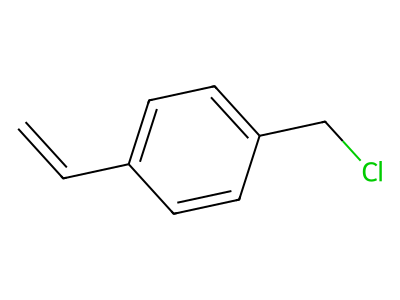
4-Vinylbenzyl chloride
Also known as: 4-(Chloromethyl)styrene, 1-(Chloromethyl)-4-ethenylbenzene, 4-Chloromethylstyrene, p-Chloromethylstyrene, 4-Vinylbenzyl chloride (stabilized), Benzene, 1-(chloromethyl)-4-ethenyl-
4-Vinylbenzyl chloride (CAS 1592-20-7) is a compound in the Aromatic Hydrocarbons category listed in the Jingsj chemical database. It has the molecular formula C9H9Cl and a molecular weight of 152.621 g/mol. Key properties include a boiling point of 228.9±9.0 °C at 760 mmHg, a density of 1.1±0.1 g/cm3 and a flash point of 105.0±0.0 °C. It is classified under GHS with signal word Danger and hazard statements H302 — Harmful if swallowed, H311 — Toxic in contact with skin and H314 — Causes severe skin burns and eye damage. No supplier offers are currently listed; request a quote. Record last updated Aug 21, 2026.
- CAS No.
- 1592-20-7
- Jingsj CID
- J-33210-5
- Molecular Formula
- C9H9Cl
- Molecular Weight
- 152.621 g/mol
- Category
- Aromatic Hydrocarbons
- Last updated
- 8/21/2026
No offers for this compound yet.
Request a quotePhysicochemical Properties
| Boiling Point | 228.9±9.0 °C at 760 mmHg |
|---|---|
| Density | 1.1±0.1 g/cm3 |
| Flash Point | 105.0±0.0 °C |
| Exact Mass | 152.039276 |
| LogP | 2.97 |
| Additional Property | 5.3 (vs air) |
| Vapor Pressure | 0.1±0.4 mmHg at 25°C |
| Refractive Index | 1.570 |
GHS Safety & Compliance
- H302 — Harmful if swallowed
- H311 — Toxic in contact with skin
- H314 — Causes severe skin burns and eye damage
- H317 — May cause an allergic skin reaction
Customs & Trade Information
| HS Code | 2903999090 |
|---|---|
| Summary | 2903999090 halogenated derivatives of aromatic hydrocarbons VAT:17.0% Tax rebate rate:9.0% Supervision conditions:none MFN tariff:5.5% General tariff:30.0% |
Frequently Asked Questions
What is the CAS number of 4-Vinylbenzyl chloride?
The CAS number of 4-Vinylbenzyl chloride is 1592-20-7.
What are the molecular formula and molecular weight of 4-Vinylbenzyl chloride?
4-Vinylbenzyl chloride has molecular formula C9H9Cl and molecular weight 152.621 g/mol.
Is 4-Vinylbenzyl chloride hazardous?
4-Vinylbenzyl chloride has GHS signal word Danger and hazard statements H302 — Harmful if swallowed; H311 — Toxic in contact with skin; H314 — Causes severe skin burns and eye damage.
What are the upstream and downstream products of 4-Vinylbenzyl chloride?
For 4-Vinylbenzyl chloride, Upstream Products: p-vinylbenzyl alcohol, 4-(Chloromethyl)benzaldehyde, 4-Methylstyrene; Downstream Products: 4-Vinylbenzylamine, N-tert-Butyl-O-[1-[4-(chloromethyl)phenyl]ethyl]-N-(2-methyl-1-phenylpropyl)hydroxylamine, 4-(Chloromethyl)benzaldehyde.
Data compiled from public chemical databases such as PubChem and supplier catalogs; supplier offers are provided by suppliers.
Last updated:
How to cite: Jingsj. "4-Vinylbenzyl chloride (CAS 1592-20-7)". Jingsj Chemical Database. https://www.jingsj.com/compound/J-33210-5 (accessed 2026-11-09).
Data for reference only; verify product details with suppliers before purchase.