
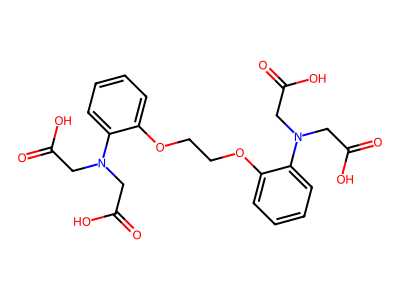
BAPTA
Also known as: 1,2-Bis(2-aminophenoxy)ethane-N,N,N',N'-tetraacetic acid, Ethylenedioxybis(o-phenylenenitrilo)tetraacetic acid, N,N'-[1,2-Ethanediylbis(oxy-2,1-phenylene)]bis[N-(carboxymethyl)glycine], 2,2',2'',2'''-[1,2-Ethanediylbis(oxy-2,1-phenylenenitrilo)]tetraacetic acid, 2,2',2'',2'''-[Ethane-1,2-diylbis(oxy-2,1-phenylenenitrilo)]tetraacetic acid, 1,2-Bis(o-aminophenoxy)ethane-N,N,N',N'-tetraacetic acid, Ethylenebis(oxy-2,1-phenylenenitrilo)tetraacetic acid, Glycine, N,N'-[1,2-ethanediylbis(oxy-2,1-phenylene)]bis[N-(carboxymethyl)-
BAPTA (CAS 85233-19-8) is a compound in the Organic Acids category listed in the Jingsj chemical database. It has the molecular formula C22H24N2O10 and a molecular weight of 476.433 g/mol. Key properties include a melting point of 177-179 °C, a boiling point of 766.6±60.0 °C at 760 mmHg, a density of 1.5±0.1 g/cm3 and a flash point of 417.4±32.9 °C. It is classified under GHS with signal word Warning and hazard statements H315 — Causes skin irritation, H319 — Causes serious eye irritation and H335 — May cause respiratory irritation. No supplier offers are currently listed; request a quote. Record last updated Aug 21, 2026.
- CAS No.
- 85233-19-8
- Jingsj CID
- J-31073-6
- Molecular Formula
- C22H24N2O10
- Molecular Weight
- 476.433 g/mol
- Category
- Organic Acids
- Last updated
- 8/21/2026
No offers for this compound yet.
Request a quotePhysicochemical Properties
| Melting Point | 177-179 °C |
|---|---|
| Boiling Point | 766.6±60.0 °C at 760 mmHg |
| Density | 1.5±0.1 g/cm3 |
| Flash Point | 417.4±32.9 °C |
| Exact Mass | 476.143097 |
| PSA | 174.14000 |
| LogP | 0.13 |
| Vapor Pressure | 0.0±2.7 mmHg at 25°C |
| Refractive Index | 1.657 |
GHS Safety & Compliance
- H315 — Causes skin irritation
- H319 — Causes serious eye irritation
- H335 — May cause respiratory irritation
Activity & Biological Data
| Target | Ca2+ chelator[1] |
|---|---|
| Additional Information | [1]. Mizutani T, et al. Sodium Lauryl Sulfate Stimulates the Generation of Reactive Oxygen Species through Interactions with Cell Membranes. J Oleo Sci. 2016 Dec 1;65(12):993-1001. [2]. Corns LF, et al. Tmc1 Point Mutation Affects Ca2+ Sensitivity and Block by Dihydrostreptomycin of the Mechanoelectrical Transducer Current of Mouse Outer Hair Cells. J Neurosci. 2016 Jan 13;36(2):336-49. |
Frequently Asked Questions
What is the CAS number of BAPTA?
The CAS number of BAPTA is 85233-19-8.
What are the molecular formula and molecular weight of BAPTA?
BAPTA has molecular formula C22H24N2O10 and molecular weight 476.433 g/mol.
Is BAPTA hazardous?
BAPTA has GHS signal word Warning and hazard statements H315 — Causes skin irritation; H319 — Causes serious eye irritation; H335 — May cause respiratory irritation.
What are the upstream and downstream products of BAPTA?
For BAPTA, Upstream Products: 1,2-Bis(2-nitrophenoxy)ethane, Sodium 2-nitrophenoxide, 2-Nitrophenol.
Data compiled from public chemical databases such as PubChem and supplier catalogs; supplier offers are provided by suppliers.
Last updated:
How to cite: Jingsj. "BAPTA (CAS 85233-19-8)". Jingsj Chemical Database. https://www.jingsj.com/compound/J-31073-6 (accessed 2026-11-09).
Data for reference only; verify product details with suppliers before purchase.