
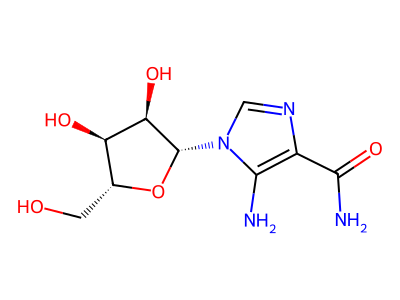
Acadesine
Also known as: AICAR, 5-Aminoimidazole-4-carboxamide-1-beta-D-ribofuranoside, 5-Amino-1-beta-D-ribofuranosyl-1H-imidazole-4-carboxamide, AICA Riboside, AIC-Riboside, Arasine, GP 1-110, 1-Deoxy-1-[(4-carbamoyl-5-amino-1H-imidazole)-1-yl]-β-D-ribofuranose, 1H-Imidazole-4-carboxamide, 5-amino-1-β-D-ribofuranosyl-
Acadesine (CAS 2627-69-2) is a compound in the Organic Compounds category listed in the Jingsj chemical database. It has the molecular formula C9H14N4O5 and a molecular weight of 258.231 g/mol. Key properties include a melting point of 214-215 °C, a boiling point of 726.3±60.0 °C at 760 mmHg, a density of 2.1±0.1 g/cm3 and a flash point of 393.1±32.9 °C. It is classified under GHS with signal word Warning and hazard statements H315 — Causes skin irritation, H319 — Causes serious eye irritation and H335 — May cause respiratory irritation. No supplier offers are currently listed; request a quote. Record last updated Aug 21, 2026.
- CAS No.
- 2627-69-2
- Jingsj CID
- J-28961-2
- Molecular Formula
- C9H14N4O5
- Molecular Weight
- 258.231 g/mol
- Category
- Organic Compounds
- Last updated
- 8/21/2026
No offers for this compound yet.
Request a quotePhysicochemical Properties
| Melting Point | 214-215 °C |
|---|---|
| Boiling Point | 726.3±60.0 °C at 760 mmHg |
| Density | 2.1±0.1 g/cm3 |
| Flash Point | 393.1±32.9 °C |
| Exact Mass | 258.096405 |
| PSA | 156.85000 |
| LogP | -2.93 |
| Vapor Pressure | 0.0±2.5 mmHg at 25°C |
| Refractive Index | 1.821 |
| Additional Property | H2O: >10 mg/mL |
GHS Safety & Compliance
- H315 — Causes skin irritation
- H319 — Causes serious eye irritation
- H335 — May cause respiratory irritation
Activity & Biological Data
| Target | AMPK Autophagy Mitophagy |
|---|---|
| Additional Information | [1]. Nakamaru K, et al. AICAR, an activator of AMP-activated protein kinase, down-regulates the insulin receptor expression in HepG2 cells. Biochem Biophys Res Commun. 2005 Mar 11;328(2):449-54 [2]. Drake JC, et al. AICAR treatment for 14 days normalizes obesity-induced dysregulation of TORC1 signaling and translational capacity in fasted skeletal muscle. Am J Physiol Regul Integr Comp Physiol. 2010 Dec;299(6):R1546-54. [3]. Pold R, et al. Long-term AICAR administration and exercise prevents diabetes in ZDF rats.Diabetes. 2005 Apr;54(4):928-34. [4]. Chen L, et al. Activating AMPK to Restore Tight Junction Assembly in Intestinal Epithelium and to Attenuate Experimental Colitis by Metformin. Front Pharmacol. 2018 Jul 16;9:761. |
Customs & Trade Information
| HS Code | 2934999090 |
|---|---|
| Summary | 2934999090. other heterocyclic compounds. VAT:17.0%. Tax rebate rate:13.0%. . MFN tariff:6.5%. General tariff:20.0% |
Frequently Asked Questions
What is the CAS number of Acadesine?
The CAS number of Acadesine is 2627-69-2.
What are the molecular formula and molecular weight of Acadesine?
Acadesine has molecular formula C9H14N4O5 and molecular weight 258.231 g/mol.
Is Acadesine hazardous?
Acadesine has GHS signal word Warning and hazard statements H315 — Causes skin irritation; H319 — Causes serious eye irritation; H335 — May cause respiratory irritation.
What are the upstream and downstream products of Acadesine?
For Acadesine, Upstream Products: Inosine, 2',3',5'-Tri-O-acetylinosine; Downstream Products: N2-Benzoylguanosine, Mizoribine, 5-Amino-1H-imidazole-4-carboxamide.
Data compiled from public chemical databases such as PubChem and supplier catalogs; supplier offers are provided by suppliers.
Last updated:
How to cite: Jingsj. "Acadesine (CAS 2627-69-2)". Jingsj Chemical Database. https://www.jingsj.com/compound/J-28961-2 (accessed 2026-11-09).
Data for reference only; verify product details with suppliers before purchase.