
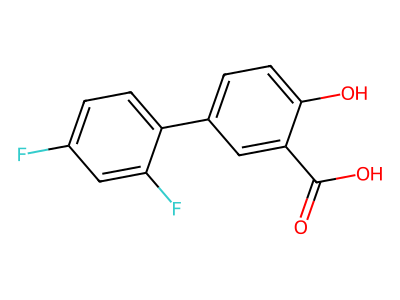
Diflunisal
Also known as: 5-(2,4-Difluorophenyl)-2-hydroxybenzoic acid, 2',4'-Difluoro-4-hydroxy-[1,1'-biphenyl]-3-carboxylic acid, 2',4'-Difluoro-4-hydroxybiphenyl-3-carboxylic acid, MK-647, Dolobid, Dolobis, Adomal, Dolisal, Dolobil, Flovacil, Fluniget, Fluodonil, Flustar, Difludol, Diflunisalum
Diflunisal (CAS 22494-42-4) is a compound in the Organohalogen Compounds category listed in the Jingsj chemical database. It has the molecular formula C13H8F2O3 and a molecular weight of 250.198 g/mol. Key properties include a melting point of 32-36 °C, a boiling point of 386.9±42.0 °C at 760 mmHg, a density of 1.4±0.1 g/cm3 and a flash point of 187.8±27.9 °C. It is classified under GHS with signal word Warning and hazard statements H302 — Harmful if swallowed, H315 — Causes skin irritation and H319 — Causes serious eye irritation. No supplier offers are currently listed; request a quote. Record last updated Aug 21, 2026.
- CAS No.
- 22494-42-4
- Jingsj CID
- J-28662-4
- Molecular Formula
- C13H8F2O3
- Molecular Weight
- 250.198 g/mol
- Category
- Organohalogen Compounds
- Last updated
- 8/21/2026
No offers for this compound yet.
Request a quotePhysicochemical Properties
| Melting Point | 32-36 °C |
|---|---|
| Boiling Point | 386.9±42.0 °C at 760 mmHg |
| Density | 1.4±0.1 g/cm3 |
| Flash Point | 187.8±27.9 °C |
| Exact Mass | 250.044144 |
| PSA | 57.53000 |
| LogP | 4.44 |
| Vapor Pressure | 0.0±0.9 mmHg at 25°C |
| Refractive Index | 1.601 |
| Storage Conditions | Refrigerator |
GHS Safety & Compliance
- H302 — Harmful if swallowed
- H315 — Causes skin irritation
- H319 — Causes serious eye irritation
- H335 — May cause respiratory irritation
- H361 — Suspected of damaging fertility or the unborn child
Activity & Biological Data
| Target | COX |
|---|---|
| Additional Information | [1]. Lin JH, et al. Dose-dependent pharmacokinetics of diflunisal in rats: dual effects of protein binding and metabolism. J Pharmacol Exp Ther. 1985 Nov;235(2):402-6. [2]. Winter CA, et al. Analgesic activity of diflunisal [MK-647; 5-(2,4-difluorophenyl)salicylic acid] in rats with hyperalgesia induced by Freund's adjuvant. J Pharmacol Exp Ther. 1979 Dec;211(3):678-85. [3]. Cappon GD, et al. Relationship between cyclooxygenase 1 and 2 selective inhibitors and fetal development when administered to rats and rabbits during the sensitive periods for heart development and midline closure. Birth Defects Res B Dev Reprod Toxicol. 2003 Feb;68(1):47-56. |
Customs & Trade Information
| HS Code | 2922299090 |
|---|---|
| Summary | 2922299090. other amino-naphthols and other amino-phenols, other than those containing more than one kind of oxygen function, their ethers and esters; salts thereof. VAT:17.0%. Tax rebate rate:13.0%. . MFN tariff:6.5%. General tariff:30.0% |
Frequently Asked Questions
What is the CAS number of Diflunisal?
The CAS number of Diflunisal is 22494-42-4.
What are the molecular formula and molecular weight of Diflunisal?
Diflunisal has molecular formula C13H8F2O3 and molecular weight 250.198 g/mol.
Is Diflunisal hazardous?
Diflunisal has GHS signal word Warning and hazard statements H302 — Harmful if swallowed; H315 — Causes skin irritation; H319 — Causes serious eye irritation.
What are the upstream and downstream products of Diflunisal?
For Diflunisal, Upstream Products: 5-Bromosalicylic acid, 2,4-Difluorophenylboronic acid, 2-iodoanisole; Downstream Products: 5-(2,4-difluorophenyl)-2-hydroxy-N-[4-nitro-3-(trifluoromethyl)phenyl]benzamide, [4-(2,4-difluorophenyl)-2-(4-methylpiperazine-1-carbonyl)phenyl] benzoate, 3-(Diethylcarbamoyl)-2',4'-difluorobiphenyl-4-yl benzoate.
Data compiled from public chemical databases such as PubChem and supplier catalogs; supplier offers are provided by suppliers.
Last updated:
How to cite: Jingsj. "Diflunisal (CAS 22494-42-4)". Jingsj Chemical Database. https://www.jingsj.com/compound/J-28662-4 (accessed 2026-11-07).
Data for reference only; verify product details with suppliers before purchase.