
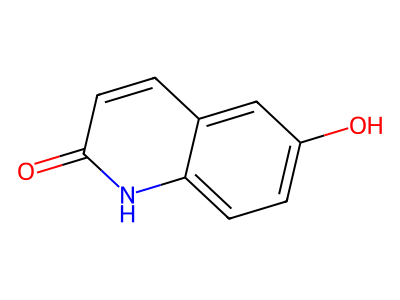
2,6-Dihydroxyquinoline
Also known as: 6-Hydroxyquinolin-2(1H)-one, 2,6-Quinolinediol, 6-Hydroxycarbostyril, 1,2-Dihydro-6-hydroxy-2-oxoquinoline, 6-Hydroxy-2(1H)-quinolinone, 6-Hydroxy-1H-quinolin-2-one, 6-Hydroxy-2-quinolinone, 6-Hydroxy-2(H)-quinolinone, 6-Hydroxyquinolin-2-one, quinoline-2,6-diol, 6-hydroxycarbostyril, 6-hydroquinilinone, 6-hydroxy-2-quinolone, AKOS 222-06
2,6-Dihydroxyquinoline (CAS 19315-93-6) is a compound in the Pharma Intermediates category listed in the Jingsj chemical database. It has the molecular formula C9H7NO2 and a molecular weight of 161.157 g/mol. Key properties include a melting point of 188-190 °C(lit.), a boiling point of 441.7±25.0 °C at 760 mmHg, a density of 1.4±0.1 g/cm3 and a flash point of 220.9±23.2 °C. It is classified under GHS with signal word Warning and hazard statements H315 — Causes skin irritation, H319 — Causes serious eye irritation and H335 — May cause respiratory irritation. No supplier offers are currently listed; request a quote. Record last updated Aug 21, 2026.
- CAS No.
- 19315-93-6
- Jingsj CID
- J-27729-2
- Molecular Formula
- C9H7NO2
- Molecular Weight
- 161.157 g/mol
- Category
- Pharma Intermediates
- Last updated
- 8/21/2026
No offers for this compound yet.
Request a quotePhysicochemical Properties
| Melting Point | 188-190 °C(lit.) |
|---|---|
| Boiling Point | 441.7±25.0 °C at 760 mmHg |
| Density | 1.4±0.1 g/cm3 |
| Flash Point | 220.9±23.2 °C |
| Exact Mass | 161.047684 |
| PSA | 53.35000 |
| LogP | 1.59 |
| Vapor Pressure | 0.0±1.1 mmHg at 25°C |
| Refractive Index | 1.743 |
GHS Safety & Compliance
- H315 — Causes skin irritation
- H319 — Causes serious eye irritation
- H335 — May cause respiratory irritation
Customs & Trade Information
| HS Code | 2933499090 |
|---|---|
| Summary | 2933499090. other compounds containing in the structure a quinoline or isoquinoline ring-system (whether or not hydrogenated), not further fused. VAT:17.0%. Tax rebate rate:13.0%. . MFN tariff:6.5%. General tariff:20.0% |
Frequently Asked Questions
What is the CAS number of 2,6-Dihydroxyquinoline?
The CAS number of 2,6-Dihydroxyquinoline is 19315-93-6.
What are the molecular formula and molecular weight of 2,6-Dihydroxyquinoline?
2,6-Dihydroxyquinoline has molecular formula C9H7NO2 and molecular weight 161.157 g/mol.
Is 2,6-Dihydroxyquinoline hazardous?
2,6-Dihydroxyquinoline has GHS signal word Warning and hazard statements H315 — Causes skin irritation; H319 — Causes serious eye irritation; H335 — May cause respiratory irritation.
What are the upstream and downstream products of 2,6-Dihydroxyquinoline?
For 2,6-Dihydroxyquinoline, Upstream Products: 6-methoxyquinolin-2(1H)-one, p-Anisidine, 6-Methoxyquinoline N-oxide; Downstream Products: 3,4-Dehydro Cilostazol, 2-Chloro-6-methoxyquinoline, 6-[3-(1-cyclohexyl-1H-tetrazol-5-yl)propoxy]quinolin-2(1H)-one.
Data compiled from public chemical databases such as PubChem and supplier catalogs; supplier offers are provided by suppliers.
Last updated:
How to cite: Jingsj. "2,6-Dihydroxyquinoline (CAS 19315-93-6)". Jingsj Chemical Database. https://www.jingsj.com/compound/J-27729-2 (accessed 2026-11-09).
Data for reference only; verify product details with suppliers before purchase.