
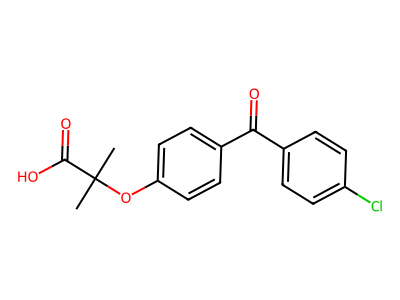
Fenofibric acid
Also known as: 2-[4-(4-Chlorobenzoyl)phenoxy]-2-methylpropanoic acid, 2-[4-(4-Chlorobenzoyl)phenoxy]-2-methylpropionic acid, Procetofenic acid, Fibricor, Fenofibrate Related Compound B, Fenofibrate impurity B, 2-(4-(4-chlorobenzoyl)phenoxy)-2-methylpropanoic acid, 2-[4-(4-chlorobenzoyl)phenoxy]-2-methyl-propanoic acid, Propanoic acid, 2-[4-(4-chlorobenzoyl)phenoxy]-2-methyl-
Fenofibric acid (CAS 42017-89-0) is a compound in the Organic Acids category listed in the Jingsj chemical database. It has the molecular formula C17H15ClO4 and a molecular weight of 318.752 g/mol. Key properties include a melting point of 176--179ºC, a boiling point of 486.5±35.0 °C at 760 mmHg, a density of 1.3±0.1 g/cm3 and a flash point of 248.0±25.9 °C. It is classified under GHS with signal word Warning and hazard statements H302 — Harmful if swallowed and H410 — Very toxic to aquatic life with long lasting effects. No supplier offers are currently listed; request a quote. Record last updated Aug 21, 2026.
- CAS No.
- 42017-89-0
- Jingsj CID
- J-22747-4
- Molecular Formula
- C17H15ClO4
- Molecular Weight
- 318.752 g/mol
- Category
- Organic Acids
- Last updated
- 8/21/2026
No offers for this compound yet.
Request a quotePhysicochemical Properties
| Melting Point | 176--179ºC |
|---|---|
| Boiling Point | 486.5±35.0 °C at 760 mmHg |
| Density | 1.3±0.1 g/cm3 |
| Flash Point | 248.0±25.9 °C |
| Exact Mass | 318.065887 |
| PSA | 63.60000 |
| LogP | 3.86 |
| Vapor Pressure | 0.0±1.3 mmHg at 25°C |
| Refractive Index | 1.585 |
| Storage Conditions | -20°C Freezer |
GHS Safety & Compliance
- H302 — Harmful if swallowed
- H410 — Very toxic to aquatic life with long lasting effects
Activity & Biological Data
| Target | PPARδ:1.06 μM (EC50) PPARγ:1.47 μM (EC50) PPARα:22.4 μM (EC50) COX-2:48 μM (IC50) |
|---|---|
| Additional Information | [1]. Dietz M, et al. Comparative molecular profiling of the PPARα/γ activator aleglitazar: PPAR selectivity, activity and interaction with cofactors. ChemMedChem. 2012 Jun;7(6):1101-11. [2]. Prasad GS, et al. Anti-inflammatory activity of anti-hyperlipidemic drug, fenofibrate, and its phase-I metabolite fenofibric acid: in silico, in vitro, and in vivo studies. Inflammopharmacology. 2017 Dec 13. [3]. Neumeier M, et al. Aldehyde oxidase 1 is highly abundant in hepatic steatosis and is downregulated by adiponectin and fenofibric acid in hepatocytes in vitro. Biochem Biophys Res Commun. 2006 Nov 24;350(3):731-5. Epub 2006 Sep 27. [4]. Miranda S, et al. Beneficial effects of fenofibrate in retinal pigment epithelium by the modulation of stress and survival signaling under diabetic conditions. J Cell Physiol. 2012 Jun;227(6):2352-62. |
Customs & Trade Information
| HS Code | 2918990090 |
|---|---|
| Summary | 2918990090. other carboxylic acids with additional oxygen function and their anhydrides, halides, peroxides and peroxyacids; their halogenated, sulphonated, nitrated or nitrosated derivatives. VAT:17.0%. Tax rebate rate:13.0%. . MFN tariff:6.5%. General tariff:30.0% |
Frequently Asked Questions
What is the CAS number of Fenofibric acid?
The CAS number of Fenofibric acid is 42017-89-0.
What are the molecular formula and molecular weight of Fenofibric acid?
Fenofibric acid has molecular formula C17H15ClO4 and molecular weight 318.752 g/mol.
Is Fenofibric acid hazardous?
Fenofibric acid has GHS signal word Warning and hazard statements H302 — Harmful if swallowed; H410 — Very toxic to aquatic life with long lasting effects.
What are the upstream and downstream products of Fenofibric acid?
For Fenofibric acid, Upstream Products: 4-Chloro-4'-hydroxybenzophenone, 2-Bromo-2-methylpropionic acid, Fenofibrate; Downstream Products: Fenofibrate, Choline fenofibrate.
Data compiled from public chemical databases such as PubChem and supplier catalogs; supplier offers are provided by suppliers.
Last updated:
How to cite: Jingsj. "Fenofibric acid (CAS 42017-89-0)". Jingsj Chemical Database. https://www.jingsj.com/compound/J-22747-4 (accessed 2026-11-09).
Data for reference only; verify product details with suppliers before purchase.