
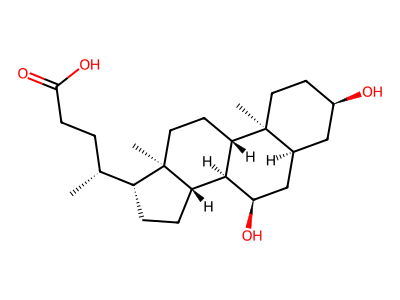
Chenodeoxycholic acid
Also known as: CDCA, Chenodiol, Chenodeoxycholate, 3alpha,7alpha-Dihydroxy-5beta-cholanic acid, Chenix, Fluibil, Kebilis, Ulmenide
Chenodeoxycholic acid (CAS 474-25-9) is a compound in the Organic Acids category listed in the Jingsj chemical database. It has the molecular formula C24H40O4 and a molecular weight of 392.572 g/mol. Key properties include a melting point of 165-167 °C(lit.), a boiling point of 547.1±25.0 °C at 760 mmHg, a density of 1.1±0.1 g/cm3 and a flash point of 298.8±19.7 °C. It is classified under GHS with signal word Warning and hazard statements H315 — Causes skin irritation and H319 — Causes serious eye irritation. No supplier offers are currently listed; request a quote. Record last updated Aug 21, 2026.
- CAS No.
- 474-25-9
- Jingsj CID
- J-1992829-1
- Molecular Formula
- C24H40O4
- Molecular Weight
- 392.572 g/mol
- Category
- Organic Acids
- Last updated
- 8/21/2026
No offers for this compound yet.
Request a quotePhysicochemical Properties
| Melting Point | 165-167 °C(lit.) |
|---|---|
| Boiling Point | 547.1±25.0 °C at 760 mmHg |
| Density | 1.1±0.1 g/cm3 |
| Flash Point | 298.8±19.7 °C |
| Exact Mass | 392.292664 |
| PSA | 77.76000 |
| LogP | 4.66 |
| Vapor Pressure | 0.0±3.3 mmHg at 25°C |
| Refractive Index | 1.543 |
| Additional Property | PRACTICALLY INSOLUBLE |
GHS Safety & Compliance
- H315 — Causes skin irritation
- H319 — Causes serious eye irritation
Activity & Biological Data
| Target | Human Endogenous Metabolite |
|---|---|
| Additional Information | [1]. Stauffer AT, et al. Chenodeoxycholic acid and deoxycholic acid inhibit 11 beta-hydroxysteroid dehydrogenase type 2 and cause cortisol-induced transcriptional activation of the mineralocorticoid receptor. J Biol Chem. 2002 Jul 19;277(29):26286-92 [2]. Casaburi I, et al. Chenodeoxycholic acid through a TGR5-dependent CREB signaling activation enhances cyclin D1 expression and promotes human endometrial cancer cell proliferation. Cell Cycle. 2012 Jul 15;11(14):2699-710 [3]. Kawabe Y, et al. The molecular mechanism of the induction of the low density lipoprotein receptor by chenodeoxycholic acid in cultured human cells. Biochem Biophys Res Commun. 1995 Mar 8;208(1):405-11. [4]. Ao M, et al. Chenodeoxycholic acid stimulates Cl(-) secretion via cAMP signaling and increases cystic fibrosis transmembrane conductance regulator phosphorylation in T84 cells. Am J Physiol Cell Physiol. 2013 Aug 15;305(4):C447-56 [5]. Noh K, et al. Farnesoid X receptor activation by chenodeoxycholic acid induces detoxifying enzymes through AMP-activated protein kinase and extracellular signal-regulated kinase 1/2-mediated phosphorylation of CCAAT/enhancer binding protein β. Drug Metab |
Customs & Trade Information
| HS Code | 2918990090 |
|---|---|
| Summary | 2918990090. other carboxylic acids with additional oxygen function and their anhydrides, halides, peroxides and peroxyacids; their halogenated, sulphonated, nitrated or nitrosated derivatives. VAT:17.0%. Tax rebate rate:13.0%. . MFN tariff:6.5%. General tariff:30.0% |
Frequently Asked Questions
What is the CAS number of Chenodeoxycholic acid?
The CAS number of Chenodeoxycholic acid is 474-25-9.
What are the molecular formula and molecular weight of Chenodeoxycholic acid?
Chenodeoxycholic acid has molecular formula C24H40O4 and molecular weight 392.572 g/mol.
Is Chenodeoxycholic acid hazardous?
Chenodeoxycholic acid has GHS signal word Warning and hazard statements H315 — Causes skin irritation; H319 — Causes serious eye irritation.
What are the upstream and downstream products of Chenodeoxycholic acid?
For Chenodeoxycholic acid, Upstream Products: Chenodeoxycholic acid diacetate methyl ester, Sodium chenodeoxycholate, Lithocholic acid; Downstream Products: 7α-Hydroxy-4-cholesten-3-one, 3α-Hydroxy-7-oxo-5β-cholanic acid, Lithocholic acid.
Data compiled from public chemical databases such as PubChem and supplier catalogs; supplier offers are provided by suppliers.
Last updated:
How to cite: Jingsj. "Chenodeoxycholic acid (CAS 474-25-9)". Jingsj Chemical Database. https://www.jingsj.com/compound/J-1992829-1 (accessed 2026-11-09).
Data for reference only; verify product details with suppliers before purchase.