
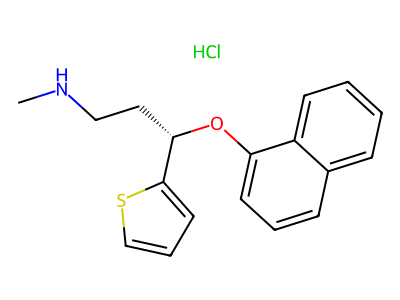
Duloxetine hydrochloride
Also known as: (+)-(S)-N-methyl-γ-(1-naphthyloxy)-2-thiophenepropylamine hydrochloride, (3S)-N-Methyl-3-(1-naphthyloxy)-3-(2-thienyl)-1-propanamine hydrochloride (1:1), (3S)-N-Methyl-3-(naphthalen-1-yloxy)-3-thiophen-2-ylpropan-1-amine hydrochloride, (S)-Duloxetine hydrochloride, (S)-N-Methyl-3-(1-naphthalenyloxy)-3-(2-thienyl)propanamine hydrochloride, (γS)-N-methyl-γ-(1-naphthalenyloxy)-2-thiophenepropanamine hydrochloride (1:1), 2-Thiophenepropanamine, N-methyl-γ-(1-naphthalenyloxy)-, (γS)-, hydrochloride (1:1), LY-248686 HCl, LY-248686 hydrochloride, Duloxetine HCl
Duloxetine hydrochloride (CAS 136434-34-9) is a compound in the Organic Acids category listed in the Jingsj chemical database. It has the molecular formula C18H20ClNOS and a molecular weight of 333.875 g/mol. Key properties include a melting point of 118-122ºC, a boiling point of 466.2ºC at 760 mmHg and a flash point of 235.7ºC. It is classified under GHS with signal word Danger and hazard statements H225 — Highly flammable liquid and vapour, H301 — Toxic if swallowed and H311 — Toxic in contact with skin. No supplier offers are currently listed; request a quote. Record last updated Aug 21, 2026.
- CAS No.
- 136434-34-9
- Jingsj CID
- J-1977624-6
- Molecular Formula
- C18H20ClNOS
- Molecular Weight
- 333.875 g/mol
- Category
- Organic Acids
- Last updated
- 8/21/2026
No offers for this compound yet.
Request a quotePhysicochemical Properties
| Melting Point | 118-122ºC |
|---|---|
| Boiling Point | 466.2ºC at 760 mmHg |
| Flash Point | 235.7ºC |
| Exact Mass | 333.095398 |
| PSA | 49.50000 |
| LogP | 5.82380 |
| Storage Conditions | -20°C Freezer |
| Additional Property | H2O: soluble5mg/mL (clear solution, warmed) |
GHS Safety & Compliance
- H225 — Highly flammable liquid and vapour
- H301 — Toxic if swallowed
- H311 — Toxic in contact with skin
- H331 — Toxic if inhaled
- H370 — Causes damage to organs
Activity & Biological Data
| Additional Information | [1]. Redrobe JP, et al. Dose-dependent noradrenergic and serotonergic properties of venlafaxine in animal models indicative of antidepressant activity. Psychopharmacology (Berl). 1998 Jul;138(1):1-8. [2]. Deecher DC, et al. Desvenlafaxine succinate: A new serotonin and norepinephrine reuptake inhibitor. J Pharmacol Exp Ther. 2006 Aug;318(2):657-65. Epub 2006 May 4. |
|---|
Customs & Trade Information
| HS Code | 2934999090 |
|---|---|
| Summary | 2934999090. other heterocyclic compounds. VAT:17.0%. Tax rebate rate:13.0%. . MFN tariff:6.5%. General tariff:20.0% |
Frequently Asked Questions
What is the CAS number of Duloxetine hydrochloride?
The CAS number of Duloxetine hydrochloride is 136434-34-9.
What are the molecular formula and molecular weight of Duloxetine hydrochloride?
Duloxetine hydrochloride has molecular formula C18H20ClNOS and molecular weight 333.875 g/mol.
Is Duloxetine hydrochloride hazardous?
Duloxetine hydrochloride has GHS signal word Danger and hazard statements H225 — Highly flammable liquid and vapour; H301 — Toxic if swallowed; H311 — Toxic in contact with skin.
What are the upstream and downstream products of Duloxetine hydrochloride?
For Duloxetine hydrochloride, Upstream Products: (S)-(+)-N,N-Dimethyl-3-(1-naphthalenyloxy)-3-(2-thienyl)propanamine, 1-Fluoronaphthalene, (S)-3-(Methylamino)-1-(2-thienyl)-1-propanol; Downstream Products: 1-Naphthol, 4-[3-(methylamino)-1-(2-thienyl)propyl]-1-naphthalenol.
Data compiled from public chemical databases such as PubChem and supplier catalogs; supplier offers are provided by suppliers.
Last updated:
How to cite: Jingsj. "Duloxetine hydrochloride (CAS 136434-34-9)". Jingsj Chemical Database. https://www.jingsj.com/compound/J-1977624-6 (accessed 2026-11-07).
Data for reference only; verify product details with suppliers before purchase.