
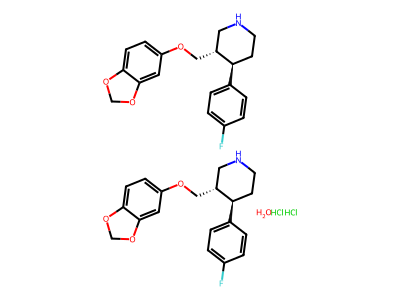
Paroxetine hydrochloride hemihydrate
Also known as: Paroxetine HCl hemihydrate, BRL29060 hydrochloride hemihydrate, BRL29060A hemihydrate, (-)-(3S,4R)-paroxetine hydrochloride hemihydrate, Piperidine, 3-[(1,3-benzodioxol-5-yloxy)methyl]-4-(4-fluorophenyl)-, hydrochloride, hydrate (2:2:1), (3S,4R)-
Paroxetine hydrochloride hemihydrate (CAS 110429-35-1) is a compound in the Organic Acids category listed in the Jingsj chemical database. It has the molecular formula C38H44Cl2F2N2O7 and a molecular weight of 749.67900 g/mol. Key properties include a melting point of 121-131ºC, a boiling point of 451.7ºC at 760mmHg, a density of 1.213g/cm3 and a flash point of 227ºC. It is classified under GHS with signal word Warning and hazard statements H302 — Harmful if swallowed, H315 — Causes skin irritation and H319 — Causes serious eye irritation. No supplier offers are currently listed; request a quote. Record last updated Nov 2, 2026.
- CAS No.
- 110429-35-1
- Jingsj CID
- J-1961585-1
- Molecular Formula
- C38H44Cl2F2N2O7
- Molecular Weight
- 749.67900 g/mol
- Category
- Organic Acids
- Last updated
- 11/2/2026
No offers for this compound yet.
Request a quotePhysicochemical Properties
| Melting Point | 121-131ºC |
|---|---|
| Boiling Point | 451.7ºC at 760mmHg |
| Density | 1.213g/cm3 |
| Flash Point | 227ºC |
| PSA | 39.72000 |
| LogP | 4.45730 |
| Appearance | white |
| Additional Property | Slightly soluble in water, freely soluble in methanol, sparingly soluble in ethanol (96 per cent) and in methylene chloride. |
GHS Safety & Compliance
- H302 — Harmful if swallowed
- H315 — Causes skin irritation
- H319 — Causes serious eye irritation
- H335 — May cause respiratory irritation
Activity & Biological Data
| Target | IC50: 14 μM (GRK2)[3] |
|---|---|
| Additional Information | [1]. Wang Q, et al. Paroxetine alleviates T lymphocyte activation and infiltration to joints of collagen-induced arthritis. Sci Rep. 2017 Mar 28;7:45364. [2]. Lassen TR, et al. Effect of paroxetine on left ventricular remodeling in an in vivo rat model of myocardial infarction. Basic Res Cardiol. 2017 May;112(3):26. [3]. Waldschmidt HV, et al. Structure-Based Design of Highly Selective and Potent G Protein-Coupled Receptor Kinase 2 Inhibitors Based on Paroxetine. J Med Chem. 2017 Apr 13;60(7):3052-3069. [4]. Liu RP, et al. Paroxetine ameliorates lipopolysaccharide-induced microglia activation via differential regulation of MAPK signaling. J Neuroinflammation. 2014 Mar 12;11:47. |
Customs & Trade Information
| HS Code | 2934999090 |
|---|---|
| Summary | 2934999090. other heterocyclic compounds. VAT:17.0%. Tax rebate rate:13.0%. . MFN tariff:6.5%. General tariff:20.0% |
Frequently Asked Questions
What is the CAS number of Paroxetine hydrochloride hemihydrate?
The CAS number of Paroxetine hydrochloride hemihydrate is 110429-35-1.
What are the molecular formula and molecular weight of Paroxetine hydrochloride hemihydrate?
Paroxetine hydrochloride hemihydrate has molecular formula C38H44Cl2F2N2O7 and molecular weight 749.67900 g/mol.
Is Paroxetine hydrochloride hemihydrate hazardous?
Paroxetine hydrochloride hemihydrate has GHS signal word Warning and hazard statements H302 — Harmful if swallowed; H315 — Causes skin irritation; H319 — Causes serious eye irritation.
What are the upstream and downstream products of Paroxetine hydrochloride hemihydrate?
For Paroxetine hydrochloride hemihydrate, Upstream Products: Sesamol, Paroxetine, 4-Fluorobenzaldehyde; Downstream Products: N-Methylparoxetine.
Data compiled from public chemical databases such as PubChem and supplier catalogs; supplier offers are provided by suppliers.
Last updated:
How to cite: Jingsj. "Paroxetine hydrochloride hemihydrate (CAS 110429-35-1)". Jingsj Chemical Database. https://www.jingsj.com/compound/J-1961585-1 (accessed 2026-11-09).
Data for reference only; verify product details with suppliers before purchase.