
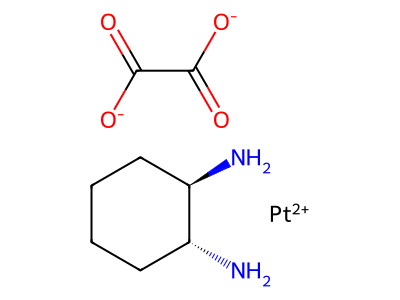
Oxaliplatin
Also known as: L-OHP, NSC 266046, Dacplat, Eloxatin, Oxalatoplatin, trans-l-Diaminocyclohexane oxalatoplatinum, (SP-4-2-(1R-trans))-(1,2-Cyclohexanediamine-N,N')[ethanedioato(2-)-O,O']platinum
Oxaliplatin (CAS 61825-94-3) is a compound in the Organic Compounds category listed in the Jingsj chemical database. It has the molecular formula C8H12N2O4Pt and a molecular weight of 395.28 g/mol. Key property: a boiling point of 193.6ºC at 760 mmHg. It is classified under GHS with signal word Warning and hazard statements H315 — Causes skin irritation, H317 — May cause an allergic skin reaction and H319 — Causes serious eye irritation. No supplier offers are currently listed; request a quote. Record last updated Aug 21, 2026.
- CAS No.
- 61825-94-3
- Jingsj CID
- J-19182-2
- Molecular Formula
- C8H12N2O4Pt
- Molecular Weight
- 395.28 g/mol
- Category
- Organic Compounds
- Last updated
- 8/21/2026
No offers for this compound yet.
Request a quotePhysicochemical Properties
| Boiling Point | 193.6ºC at 760 mmHg |
|---|---|
| PSA | 104.64000 |
| LogP | 0.61450 |
| Appearance | solid |
| Additional Property | Slightly soluble in water, very slightly soluble in methanol, practically insoluble in anhydrous ethanol. | Soluble in water with heating and/or sonication |
GHS Safety & Compliance
- H315 — Causes skin irritation
- H317 — May cause an allergic skin reaction
- H319 — Causes serious eye irritation
- H335 — May cause respiratory irritation
- H351 — Suspected of causing cancer
Activity & Biological Data
| Additional Information | [1]. Raymond E, et al. Oxaliplatin: a review of preclinical and clinical studies. Ann Oncol. 1998 Oct;9(10):1053-71. [2]. Mohammed MQ, et al. Oxaliplatin is active in vitro against human melanoma cell lines: comparison with cisplatin and carboplatin. Anticancer Drugs. 2000 Nov;11(10):859-63. [3]. Pendyala L, et al. In vitro cytotoxicity, protein binding, red blood cell partitioning, and biotransformation of oxaliplatin. Cancer Res. 1993 Dec 15;53(24):5970-6. [4]. Wang Z, et al. Oxaliplatin induces apoptosis in hepatocellular carcinoma cells and inhibits tumor growth. Expert Opin Investig Drugs. 2009 Nov;18(11):1595-604 [5]. Mathé G, et al. Oxalato-platinum or 1-OHP, a third-generation platinum complex: an experimental and clinical appraisal and preliminary comparison with cis-platinum and carboplatinum. Biomed Pharmacother. 1989;43(4):237-50. [6]. Schellingerhout D, et al. Impairment of retrograde neuronal transport in oxaliplatin-induced neuropathy demonstrated by molecular imaging. PLoS One. 2012;7(9):e45776. doi: 10.1371/journal.pone.0045776. Epub 2012 Sep 20. [7]. Romero HK, et al. Inhibition of α9α10 nicotinic acetylcholine receptors prevents chemotherapy-induced neuropathic pain. Proc Natl Acad Sci U S A. 2017 Mar 7;114(10):E1825-E1832. |
|---|
Frequently Asked Questions
What is the CAS number of Oxaliplatin?
The CAS number of Oxaliplatin is 61825-94-3.
What are the molecular formula and molecular weight of Oxaliplatin?
Oxaliplatin has molecular formula C8H12N2O4Pt and molecular weight 395.28 g/mol.
Is Oxaliplatin hazardous?
Oxaliplatin has GHS signal word Warning and hazard statements H315 — Causes skin irritation; H317 — May cause an allergic skin reaction; H319 — Causes serious eye irritation.
What are the upstream and downstream products of Oxaliplatin?
For Oxaliplatin, Upstream Products: Potassium tetrachloroplatinate(II), (1R,2R)-(-)-1,2-Diaminocyclohexane, Oxalic acid.
Data compiled from public chemical databases such as PubChem and supplier catalogs; supplier offers are provided by suppliers.
Last updated:
How to cite: Jingsj. "Oxaliplatin (CAS 61825-94-3)". Jingsj Chemical Database. https://www.jingsj.com/compound/J-19182-2 (accessed 2026-11-09).
Data for reference only; verify product details with suppliers before purchase.