
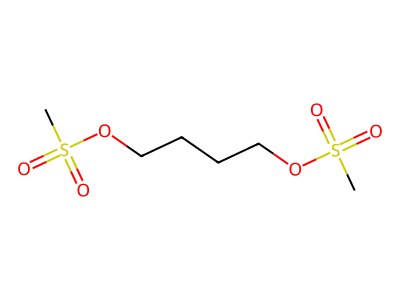
Busulfan
Also known as: 1,4-Butanediol dimethanesulfonate, 1,4-Bis(methanesulfonyloxy)butane, 1,4-Butanediol dimesylate, 1,4-Di(methanesulfonyloxy)butane, 1,4-dimethanesulfonoxybutane, Tetramethylene bis(methanesulfonate), Tetramethylene di(methanesulfonate), Butane-1,4-diyl dimethanesulfonate, Myleran, Busulfex, Busulphan, Leucosulfan, Mielucin, Misulban, Mitosan, Mitostan, Myeloleukon, Myelosan, Mylecytan, 2041 C.B.
Busulfan (CAS 55-98-1) is a compound in the Organic Compounds category listed in the Jingsj chemical database. It has the molecular formula C6H14O6S2 and a molecular weight of 246.302 g/mol. Key properties include a melting point of 114-117 °C(lit.), a boiling point of 464.0±28.0 °C at 760 mmHg, a density of 1.4±0.1 g/cm3 and a flash point of 234.4±24.0 °C. It is classified under GHS with signal word Danger and hazard statements H225 — Highly flammable liquid and vapour, H301 — Toxic if swallowed and H311 — Toxic in contact with skin. No supplier offers are currently listed; request a quote. Record last updated Aug 21, 2026.
- CAS No.
- 55-98-1
- Jingsj CID
- J-1312241-3
- Molecular Formula
- C6H14O6S2
- Molecular Weight
- 246.302 g/mol
- Category
- Organic Compounds
- Last updated
- 8/21/2026
No offers for this compound yet.
Request a quotePhysicochemical Properties
| Melting Point | 114-117 °C(lit.) |
|---|---|
| Boiling Point | 464.0±28.0 °C at 760 mmHg |
| Density | 1.4±0.1 g/cm3 |
| Flash Point | 234.4±24.0 °C |
| Exact Mass | 246.023178 |
| PSA | 103.50000 |
| LogP | -0.52 |
| Vapor Pressure | 0.0±1.1 mmHg at 25°C |
| Refractive Index | 1.471 |
| Storage Conditions | Hygroscopic, Refrigerator, Under Inert Atmosphere |
| Stability | Moisture Sensitive |
| Additional Property | Decomposes |
GHS Safety & Compliance
- H225 — Highly flammable liquid and vapour
- H301 — Toxic if swallowed
- H311 — Toxic in contact with skin
- H331 — Toxic if inhaled
- H370 — Causes damage to organs
Activity & Biological Data
| Target | DNA Alkylator[1] |
|---|---|
| Additional Information | [1]. Probin V, et al. Busulfan-induced senescence is dependent on ROS production upstream of the MAPK pathway. Free Radic Biol Med. 2007 Jun 15;42(12):1858-65. Epub 2007 Mar 31. [2]. Choi YJ, et al. Murine male germ cell apoptosis induced by busulfan treatment correlates with loss of c-kit-expression in a Fas/FasL- and p53-independent manner. FEBS Lett. 2004 Sep 24;575(1-3):41-51. [3]. Yoshida M, et al. Reduction of primordial follicles caused by maternal treatment with busulfan promotes endometrial adenocarcinoma development in donryu rats. J Reprod Dev. 2005 Dec;51(6):707-14. Epub 2005 Sep 22. |
Customs & Trade Information
| HS Code | 2942000000 |
|---|
Frequently Asked Questions
What is the CAS number of Busulfan?
The CAS number of Busulfan is 55-98-1.
What are the molecular formula and molecular weight of Busulfan?
Busulfan has molecular formula C6H14O6S2 and molecular weight 246.302 g/mol.
Is Busulfan hazardous?
Busulfan has GHS signal word Danger and hazard statements H225 — Highly flammable liquid and vapour; H301 — Toxic if swallowed; H311 — Toxic in contact with skin.
What are the upstream and downstream products of Busulfan?
For Busulfan, Upstream Products: 1,4-Butanediol, Tetrahydrofuran, Methanesulfonyl bromide; Downstream Products: 1-Phenylpyrrolidine, 1,4-Diiodobutane, 2,7-Dithiaoctane.
Data compiled from public chemical databases such as PubChem and supplier catalogs; supplier offers are provided by suppliers.
Last updated:
How to cite: Jingsj. "Busulfan (CAS 55-98-1)". Jingsj Chemical Database. https://www.jingsj.com/compound/J-1312241-3 (accessed 2026-11-09).
Data for reference only; verify product details with suppliers before purchase.