
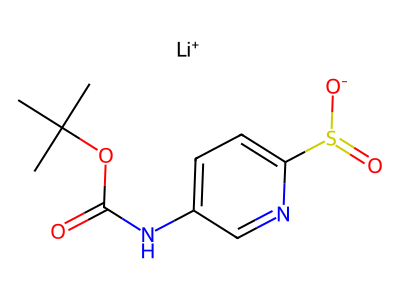
Lithium(1+) ion 5-{[(tert-butoxy)carbonyl]amino}pyridine-2-sulfinate
5-{[(叔丁氧基)羰基]氨基}吡啶-2-亚磺酸锂(1+) Wait, I need to reconsider this carefully. The input is "Lithium(1+) ion 5-{[(tert-butoxy)carbonyl]amino}pyridine-2-sulfinate" This is a lithium salt of an organic sulfinate ion. Let me break it down: - Lithium(1+) ion = 锂离子 - 5-{[(tert-butoxy)carbonyl]amino}pyridine-2-sulfinate = 5-{[(叔丁氧基)羰基]氨基}吡啶-2-亚磺酸根 The anion is: 5-{[(tert-butoxy)carbonyl]amino}pyridine-2-sulfinate tert-butoxy = 叔丁氧基 carbonyl = 羰基 amino = 氨基 pyridine = 吡啶 sulfinate = 亚磺酸根/亚磺酸盐 The full name as a salt would be: 5-{[(叔丁氧基)羰基]氨基}吡啶-2-亚磺酸锂 Actually, since it's "Lithium(1+) ion" followed by the anion name, this is likely a salt where the lithium cation balances the negative charge of the sulfinate anion. Let me think about this more carefully. "Sulfinate" refers to R-SO₂⁻, which is a sulfinate anion. So this is the lithium salt of 5-{[(tert-butoxy)carbonyl]amino}pyridine-2-sulfinic acid. The name would be: 5-{[(叔丁氧基)羰基]氨基}吡啶-2-亚磺酸锂 Or possibly: 5-(叔丁氧羰基氨基)吡啶-2-亚磺酸锂 But the "tert-butoxy)carbonyl" group is the common Boc protecting group, which in Chinese can be "叔丁氧羰基" or "Boc". Let me go with a precise systematic name. Actually, I should be careful about "亚磺酸盐" vs "亚磺酸锂". Since the input specifies "Lithium(1+) ion" and then the sulfinate anion, this is a salt. The standard naming convention for such salts is ...酸锂 (e.g., 苯亚磺酸锂). So: 5-{[(叔丁氧基)羰基]氨基}吡啶-2-亚磺酸锂 Actually, I realize "tert-butoxycarbonyl" is commonly written as "叔丁氧羰基" as one unit rather than "叔丁氧基)羰基". Let me reconsider: the name should properly be: 5-(叔丁氧羰基氨基)吡啶-2-亚磺酸锂 Or more systematically: 5-{[(叔丁氧基)羰基]氨基}吡啶-2-亚磺酸锂 Hmm, I think the proper Chinese name for this organic salt would be quite complex. Let me try to be as accurate as possible. The input appears to be a lithium salt of an organic compound with a sulfinate group. The core structure is a pyridine ring substituted at position 2 with a sulfinate group and at position 5 with a tert-butoxycarbonylamino group. I'll output: 5-{[(叔丁氧基)羰基]氨基}吡啶-2-亚磺酸锂
Lithium(1+) ion 5-{[(tert-butoxy)carbonyl]amino}pyridine-2-sulfinate (CAS 2172496-82-9) is a compound in the Pharma Intermediates category listed in the Jingsj chemical database. It has the molecular formula C10H13LiN2O4S and a molecular weight of 264.3 g/mol. No supplier offers are currently listed; request a quote. Record last updated Aug 21, 2026.
- CAS No.
- 2172496-82-9
- Jingsj CID
- J-1124149-2
- Molecular Formula
- C10H13LiN2O4S
- Chinese Name
- 5-{[(叔丁氧基)羰基]氨基}吡啶-2-亚磺酸锂(1+) Wait, I need to reconsider this carefully. The input is "Lithium(1+) ion 5-{[(tert-butoxy)carbonyl]amino}pyridine-2-sulfinate" This is a lithium salt of an organic sulfinate ion. Let me break it down: - Lithium(1+) ion = 锂离子 - 5-{[(tert-butoxy)carbonyl]amino}pyridine-2-sulfinate = 5-{[(叔丁氧基)羰基]氨基}吡啶-2-亚磺酸根 The anion is: 5-{[(tert-butoxy)carbonyl]amino}pyridine-2-sulfinate tert-butoxy = 叔丁氧基 carbonyl = 羰基 amino = 氨基 pyridine = 吡啶 sulfinate = 亚磺酸根/亚磺酸盐 The full name as a salt would be: 5-{[(叔丁氧基)羰基]氨基}吡啶-2-亚磺酸锂 Actually, since it's "Lithium(1+) ion" followed by the anion name, this is likely a salt where the lithium cation balances the negative charge of the sulfinate anion. Let me think about this more carefully. "Sulfinate" refers to R-SO₂⁻, which is a sulfinate anion. So this is the lithium salt of 5-{[(tert-butoxy)carbonyl]amino}pyridine-2-sulfinic acid. The name would be: 5-{[(叔丁氧基)羰基]氨基}吡啶-2-亚磺酸锂 Or possibly: 5-(叔丁氧羰基氨基)吡啶-2-亚磺酸锂 But the "tert-butoxy)carbonyl" group is the common Boc protecting group, which in Chinese can be "叔丁氧羰基" or "Boc". Let me go with a precise systematic name. Actually, I should be careful about "亚磺酸盐" vs "亚磺酸锂". Since the input specifies "Lithium(1+) ion" and then the sulfinate anion, this is a salt. The standard naming convention for such salts is ...酸锂 (e.g., 苯亚磺酸锂). So: 5-{[(叔丁氧基)羰基]氨基}吡啶-2-亚磺酸锂 Actually, I realize "tert-butoxycarbonyl" is commonly written as "叔丁氧羰基" as one unit rather than "叔丁氧基)羰基". Let me reconsider: the name should properly be: 5-(叔丁氧羰基氨基)吡啶-2-亚磺酸锂 Or more systematically: 5-{[(叔丁氧基)羰基]氨基}吡啶-2-亚磺酸锂 Hmm, I think the proper Chinese name for this organic salt would be quite complex. Let me try to be as accurate as possible. The input appears to be a lithium salt of an organic compound with a sulfinate group. The core structure is a pyridine ring substituted at position 2 with a sulfinate group and at position 5 with a tert-butoxycarbonylamino group. I'll output: 5-{[(叔丁氧基)羰基]氨基}吡啶-2-亚磺酸锂
- Molecular Weight
- 264.3 g/mol
- Category
- Pharma Intermediates
- Last updated
- 8/21/2026
No offers for this compound yet.
Request a quoteFrequently Asked Questions
What is the CAS number of Lithium(1+) ion 5-{[(tert-butoxy)carbonyl]amino}pyridine-2-sulfinate?
The CAS number of Lithium(1+) ion 5-{[(tert-butoxy)carbonyl]amino}pyridine-2-sulfinate is 2172496-82-9.
What are the molecular formula and molecular weight of Lithium(1+) ion 5-{[(tert-butoxy)carbonyl]amino}pyridine-2-sulfinate?
Lithium(1+) ion 5-{[(tert-butoxy)carbonyl]amino}pyridine-2-sulfinate has molecular formula C10H13LiN2O4S and molecular weight 264.3 g/mol.
Data compiled from public chemical databases and supplier catalogs; supplier offers are provided by suppliers.
Last updated:
How to cite: Jingsj. "Lithium(1+) ion 5-{[(tert-butoxy)carbonyl]amino}pyridine-2-sulfinate (CAS 2172496-82-9)". Jingsj Chemical Database. https://www.jingsj.com/compound/J-1124149-2 (accessed 2026-10-23).
Data for reference only; verify specifications, grades and regulatory status with suppliers before purchase.