
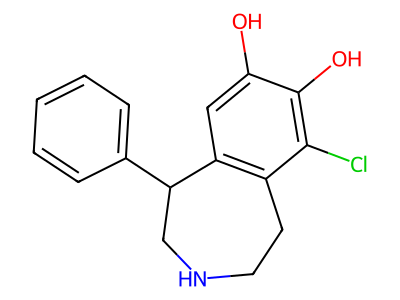
(±)-6-Chloro-7,8-dihydroxy-1-phenyl-2,3,4,5-tetrahydro-1H-3-benzazepine hydrobromide
Also known as: (+/-)-6-Chloro-7,8-dihydroxy-1-phenyl-2,3,4,5-tetrahydro-1H-3-benzazepine hydrobromide, SKF-81297 hydrobromide, (±)-6-Chloro-PB hydrobromide, (+/-)-SKF-81297 hydrobromide, 6-Chloro-1-phenyl-2,3,4,5-tetrahydro-1H-3-benzazepine-7,8-diol, 2,3,4,5-Tetrahydro-6-chloro-1-phenyl-1H-3-benzazepine-7,8-diol, 9-Chloro-5-phenyl-2,3,4,5-tetrahydro-1H-3-benzazepine-7,8-diol, MFCD00153782
(±)-6-Chloro-7,8-dihydroxy-1-phenyl-2,3,4,5-tetrahydro-1H-3-benzazepine hydrobromide (CAS 71636-61-8) is a compound in the Organic Acids category listed in the Jingsj chemical database. It has the molecular formula C16H16ClNO2 and a molecular weight of 289.76200 g/mol. Key properties include a boiling point of 467.3ºC at 760 mmHg, a density of 1.299 g/cm3 and a flash point of 236.4ºC. It is classified under GHS with signal word Warning and hazard statements H315 — Causes skin irritation, H319 — Causes serious eye irritation and H335 — May cause respiratory irritation. No supplier offers are currently listed; request a quote. Record last updated Nov 2, 2026.
- CAS No.
- 71636-61-8
- Jingsj CID
- J-1067462-1
- Molecular Formula
- C16H16ClNO2
- Molecular Weight
- 289.76200 g/mol
- Category
- Organic Acids
- Last updated
- 11/2/2026
No offers for this compound yet.
Request a quotePhysicochemical Properties
| Boiling Point | 467.3ºC at 760 mmHg |
|---|---|
| Density | 1.299 g/cm3 |
| Flash Point | 236.4ºC |
| Exact Mass | 369.01300 |
| PSA | 52.49000 |
| LogP | 4.31570 |
GHS Safety & Compliance
- H315 — Causes skin irritation
- H319 — Causes serious eye irritation
- H335 — May cause respiratory irritation
Activity & Biological Data
| Target | D1 Receptor |
|---|---|
| Additional Information | [1]. Vermeulen RJ, et al. The selective dopamine D1 receptor agonist, SKF 81297, stimulates motor behaviour of MPTP-lesioned monkeys. Eur J Pharmacol. 1993 Apr 22;235(1):143-7. [2]. Auger ML, et al. Amelioration of cognitive impairments induced by GABA hypofunction in the male rat prefrontal cortex by direct and indirect dopamine D1 agonists SKF-81297 and d-Govadine. Neuropharmacology. 2020 Jan 1;162:107844. |
Frequently Asked Questions
What is the CAS number of (±)-6-Chloro-7,8-dihydroxy-1-phenyl-2,3,4,5-tetrahydro-1H-3-benzazepine hydrobromide?
The CAS number of (±)-6-Chloro-7,8-dihydroxy-1-phenyl-2,3,4,5-tetrahydro-1H-3-benzazepine hydrobromide is 71636-61-8.
What are the molecular formula and molecular weight of (±)-6-Chloro-7,8-dihydroxy-1-phenyl-2,3,4,5-tetrahydro-1H-3-benzazepine hydrobromide?
(±)-6-Chloro-7,8-dihydroxy-1-phenyl-2,3,4,5-tetrahydro-1H-3-benzazepine hydrobromide has molecular formula C16H16ClNO2 and molecular weight 289.76200 g/mol.
Is (±)-6-Chloro-7,8-dihydroxy-1-phenyl-2,3,4,5-tetrahydro-1H-3-benzazepine hydrobromide hazardous?
(±)-6-Chloro-7,8-dihydroxy-1-phenyl-2,3,4,5-tetrahydro-1H-3-benzazepine hydrobromide has GHS signal word Warning and hazard statements H315 — Causes skin irritation; H319 — Causes serious eye irritation; H335 — May cause respiratory irritation.
What are the upstream and downstream products of (±)-6-Chloro-7,8-dihydroxy-1-phenyl-2,3,4,5-tetrahydro-1H-3-benzazepine hydrobromide?
For (±)-6-Chloro-7,8-dihydroxy-1-phenyl-2,3,4,5-tetrahydro-1H-3-benzazepine hydrobromide, Upstream Products: Styrene oxide, 2-Chloro-3,4-dimethoxyphenethylamine, (2-chloro-3,4-dimethoxyphenyl)acetonitrile.
Data compiled from public chemical databases such as PubChem and supplier catalogs; supplier offers are provided by suppliers.
Last updated:
How to cite: Jingsj. "(±)-6-Chloro-7,8-dihydroxy-1-phenyl-2,3,4,5-tetrahydro-1H-3-benzazepine hydrobromide (CAS 71636-61-8)". Jingsj Chemical Database. https://www.jingsj.com/compound/J-1067462-1 (accessed 2026-11-09).
Data for reference only; verify product details with suppliers before purchase.