
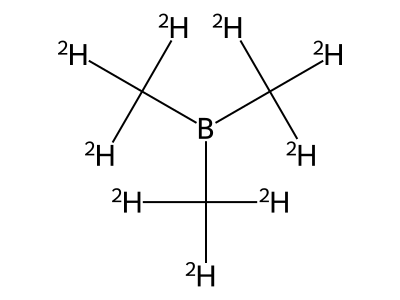
三甲基硼-d9
别名 / 同义词: 三甲基硼-d9
三甲基硼-d9(CAS 6063-55-4)是晶世纪化学数据库收录的有机化合物。分子式为 C3BD9,分子量为 64.97000 g/mol。主要理化性质包括熔点 -161.5ºC、沸点 -20,2ºC。目前暂无供应商报价,可通过联系页询价。数据更新于 2026年8月21日。
- CAS号
- 6063-55-4
- 晶世纪编号
- J-14141-1
- 分子式
- C3BD9
- 分子量
- 64.97000 g/mol
- 分类
- 有机化合物
- 更新时间
- 2026/8/21
该化合物暂无报价。
获取报价基础理化性质
| 熔点 | -161.5ºC |
|---|---|
| 沸点 | -20,2ºC |
| 精确质量 | 65.13620 |
| LogP | 1.37060 |
| 储存条件 | 密封于避光处保存,温度不宜超过52°C |
| 稳定性 | 常温常压下稳定,避免强氧化剂,卤素 |
| 计算化学 | 1.疏水参数计算参考值(XlogP):无 2.氢键供体数量:0 3.氢键受体数量:0 4.可旋转化学键数量:0 5.互变异构体数量:无 6.拓扑分子极性表面积0 7.重原子数量:4 8.表面电荷:0 9.复杂度:8 10.同位素原子数量:9 11.确定原子立构中心数量:0 12.不确定原子立构中心数量:0 13.确定化学键立构中心数量:0 14.不确定化学键立构中心数量:0 15.共价键单元数量:1 |
| 更多 | 1. 性状:未确定 2. 密度(g/mLat 25°C):未确定 3. 相对蒸汽密度(g/mL,空气=1):2.3 4. 熔点(ºC):-161.5 5. 沸点(ºC,常压):未确定 6. 沸点(ºC,760mmHg):-20.2 7. 折射率(n20/D):未确定 8. 闪点(ºC):未确定 9. 比旋光度(º):未确定 10. 自燃点或引燃温度(ºC):未确定 11. 蒸气压(mmHg,37ºC):未确定 12. 饱和蒸气压(kPa,114.4 ºC):未确定 13. 燃烧热(KJ/mol):未确定 14. 临界温度(ºC):未确定 15. 临界压力(MPa):未确定 16. 油水(辛醇/水)分配系数的对数值:未确定 17. 爆炸上限(%,V/V):未确定 18. 爆炸下限(%,V/V):未确定 19. 溶解性:未确定 |
MSDS(安全技术说明书)
Version 1.2
Regulation (EC) No 1907/2006
________________________________________________________________________
1 - Product and Company Information
________________________________________________________________________
Product NameTRIMETHYLBORON-D9, 99 ATOM % D,
ELECTRON IC GRADE
Product Number463426
Company
Century Ba-Shi Building 22A-B,
200020 Shanghai
Technical Phone #86-21-61415566
Fax 86-21-61415567
E-mail Address
________________________________________________________________________
2 - Hazards Identification
________________________________________________________________________
SPECIAL INDICATION OF HAZARDS TO HUMANS AND THE ENVIRONMENT
Spontaneously flammable in air. Causes burns.
________________________________________________________________________
3 - Composition/Information on Ingredients
________________________________________________________________________
Product NameCAS #EC noAnnex I
Index Number
TRIMETHYLBORON-D9, 99 ATOM % D, 6063-55-4 None005-004-00-6
ELECTRONICGRADE
FormulaC3 BD9
Molecular Weight 64,9900 AMU
________________________________________________________________________
4 - First Aid Measures
________________________________________________________________________
AFTER INHALATION
If inhaled, remove to fresh air. If not breathing give
artificial respiration. If breathing is difficult, give oxygen.
AFTER SKIN CONTACT
In case of skin contact, flush with copious amounts of water for
at least 15 minutes. Remove contaminated clothing and shoes.
Call a physician.
AFTER EYE CONTACT
Contamination of the eyes should be treated by immediate and
prolonged irrigation with copious amounts of water.
AFTER INGESTION
If swallowed, wash out mouth with water provided person is
conscious. Call a physician immediately.
GENERAL INFORMATION
Contamination of the eyes should be treated by immediate and
prolonged irrigation with copious amounts of water.
________________________________________________________________________
5 - Fire Fighting Measures
________________________________________________________________________
SPECIAL RISKS
Specific Hazard(s): Vapor may travel considerable distance to
source of ignition and flash back. Pyrophoric material. Emits
toxic fumes under fire conditions.
Explosion Hazards: Vapor may travel considerable distance to
source of ignition and flash back. Container explosion may occur
under fire conditions.
SPECIAL PROTECTIVE EQUIPMENT FOR FIREFIGHTERS
Wear self-contained breathing apparatus and protective clothing
to prevent contact with skin and eyes.
________________________________________________________________________
6 - Accidental Release Measures
________________________________________________________________________
PERSONAL PRECAUTION PROCEDURES TO BE FOLLOWED IN CASE OF LEAK OR SPILL
Evacuate area and keep personnel upwind. Shut off all sources of
ignition. Shut off leak if there is no risk.
PROCEDURE(S) OF PERSONAL PRECAUTION(S)
Wear self-contained breathing apparatus, rubber boots, and heavy
rubber gloves.
METHODS FOR CLEANING UP
Ventilate area and wash spill site after material pickup is
complete.
________________________________________________________________________
7 - Handling and Storage
________________________________________________________________________
HANDLING
Directions for Safe Handling: Do not breathe gas. Do not get in
eyes, on skin, on clothing. Avoid prolonged or repeated exposure.
STORAGE
Conditions of Storage: Keep tightly closed. Keep away from heat,
sparks, and open flame. Cylinder temperature should not exceed
125°F (52°C).
SPECIAL REQUIREMENTS: Contents under pressure.
________________________________________________________________________
8 - Exposure Controls / Personal Protection
________________________________________________________________________
ENGINEERING CONTROLS
Use only in a chemical fume hood. Safety shower and eye bath. Use
nonsparking tools.
GENERAL HYGIENE MEASURES
Wash thoroughly after handling.
PERSONAL PROTECTIVE EQUIPMENT
Special Protective Measures: Wear appropriate government approved
respirator, chemical-resistant gloves, safety goggles, other
protective clothing.
________________________________________________________________________
9 - Physical and Chemical Properties
________________________________________________________________________
pH N/A
BP/BP Range- 20,200 °C.760,000 mmHg
MP/MP Range- 161,500 °C.
Flash PointN/A
FlammabilityN/A
Autoignition TempN/A
Oxidizing Properties N/A
Explosive Properties N/A
Explosion LimitsN/A
Vapor PressureN/A
Partition Coefficient N/A
ViscosityN/A
Vapor Density2,300 g/l
Saturated Vapor Conc. N/A
Evaporation RateN/A
Bulk DensityN/A
Decomposition Temp.N/A
Solvent ContentN/A
Water ContentN/A
Surface TensionN/A
ConductivityN/A
Miscellaneous DataN/A
SolubilityN/A
________________________________________________________________________
10 - Stability and Reactivity
________________________________________________________________________
STABILITY
Stable: Stable.
Reactions to Avoid: Reacts violently with:
Materials to Avoid: Water, Strong oxidizing agents, Halogens.
HAZARDOUS DECOMPOSITION PRODUCTS
Hazardous Decomposition Products: Borane/boron oxides, Methane gas.
HAZARDOUS POLYMERIZATION
Hazardous Polymerization: Will not occur
________________________________________________________________________
11 - Toxicological Information
________________________________________________________________________
SIGNS AND SYMPTOMS OF EXPOSURE
Coughing, chest pains, difficulty in breathing. Nausea,
headache, and vomiting. Exposure can cause:
ROUTE OF EXPOSURE
Skin Contact: Thermal burns.
Multiple Routes: Harmful if inhaled or absorbed through skin.
________________________________________________________________________
12 - Ecological Information
________________________________________________________________________
No data available.
________________________________________________________________________
13 - Disposal Considerations
________________________________________________________________________
SUBSTANCE DISPOSAL
Observe all federal, state, and local environmental regulations.
CONTAMINATED CONTAINER DISPOSAL
Caution: no-return cylinder. Do not reuse. Empty cylinder will
contain hazardous residue. Follow proper disposal techniques.
________________________________________________________________________
14 - Transport Information
________________________________________________________________________
RID/ADR
UN#: 3160
Class: 2.3
Subrisk: 2.1
Proper Shipping Name: Liquefied gas, toxic, flammable,
n.o.s.
IMDG
UN#: 3160
Class: 2.3
Subrisk: 2.1
Proper Shipping Name: Liquefied gas, toxic, flammable,
n.o.s.
Marine Pollutant: No
Severe Marine Pollutant: No
Technical Name: Required
IATA
UN#: 3160
Class: 2.3
Subrisk: 2.1
Proper Shipping Name: Liquefied gas, toxic, flammable,
n.o.s.
Inhalation Packing Group I: No
Technical Name: Required
________________________________________________________________________
15 - Regulatory Information
________________________________________________________________________
CLASSIFICATION AND LABELING ACCORDING TO EU DIRECTIVES
ANNEX I INDEX NUMBER: 005-004-00-6
NOTA: A
INDICATION OF DANGER: F-C
Highly Flammable. Corrosive.
R-PHRASES: 17-34
Spontaneously flammable in air. Causes burns.
S-PHRASES: 7-23-26-36/37/39-43-45
Keep container tightly closed. Do not breathe vapor. In case of
contact with eyes, rinse immediately with plenty of water and
seek medical advice. Wear suitable protective clothing, gloves,
and eye/face protection. In case of fire, use dry powder. Never
use water. In case of accident or if you feel unwell, seek
medical advice immediately (show the label where possible).
Caution: Substance not yet fully tested (EU).
COUNTRY SPECIFIC INFORMATION
Germany
WGK: 1
Self-Classification
________________________________________________________________________
16 - Other Information
________________________________________________________________________
WARRANTY
The above information is believed to be correct but does not
purport to be all inclusive and shall be used only as a guide. The
information in this document is based on the present state of our
knowledge and is applicable to the product with regard to
appropriate safety precautions. It does not represent any
shall not be held liable for any damage resulting from handling or
from contact with the above product. See reverse side of invoice
or packing slip for additional terms and conditions of sale.
unlimitedpaper copies for internal use only.
DISCLAIMER
For R&D use only. Not for drug, household or other uses.
模块 15 - 法规信息
N/A
模块16 - 其他信息
N/A
常见问题
三甲基硼-d9 的 CAS 号是多少?
三甲基硼-d9 的 CAS 号是 6063-55-4。
三甲基硼-d9 的分子式和分子量是什么?
三甲基硼-d9 的分子式为 C3BD9,分子量为 64.97000 g/mol。
数据来自公开化学数据库与供应商目录;供应商报价由供应商提供。
更新时间:
引用格式: 晶世纪. “三甲基硼-d9 (CAS 6063-55-4)”. 晶世纪化学数据库. https://www.jingsj.com/zh/compound/J-14141-1(访问日期:2026-10-27)。
数据仅供参考;采购前请与供应商核实规格、等级与法规状态。